Tag: healthcare

  • Case Example #2: Positional Saphenous and Posterior Tibial SSEP Changes During L2-4 Prone Transpsoas (PTP) Fusion

    Case Example #2: Positional Saphenous and Posterior Tibial SSEP Changes During L2-4 Prone Transpsoas (PTP) Fusion


    This case describes three separate interventions for positional lower extremity SSEP changes over the course of the first half of a L2-4 PTP with varying degrees of improvement in SSEP data. Interestingly, the evoked potential of most concern (left saphenous) remained the most stable compared to other waveforms throughout the procedure.

    Most of these changes occur either before retractors are placed, or on the contralateral side of interbody placement (working from left side). We show that it is possible to develop SSEP changes via overtightening of pelvic hip pads + strap.


    Patient was a 77 year old male with a history of low back and left-sided leg pain into his knee. He is 180cm tall and weighs 103kg. He denied any focal weakness. He has a history of previous left knee arthritis and replacement, coronary artery disease, and bladder cancer. He has lumbar stenosis, spondylosis with radiculopathy, and lumbar spondylolisthesis at the L2-4 levels.


    Patient was positioned in the standard position for the prone transpsoas (PTP) approach (ATEC). Patient was turned on a Jackson table with chest and hip pads placed in the traditional fashion. Hip pads were secured with strap across buttocks.
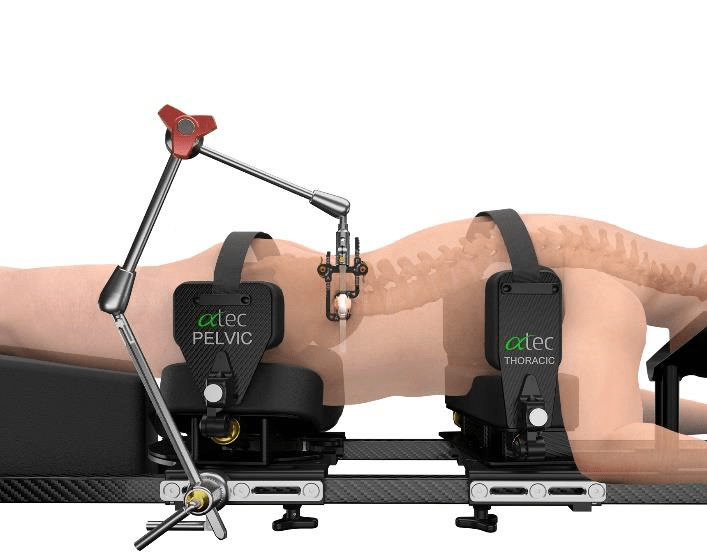
    PTP Patient Positioner – ATEC Spine


    Neuromonitoring included Somatosensory Evoked Potentials (SSEP) of the Posterior Tibial (standard ankle stimulation) and Saphenous (proximal- needle electrodes placed in thigh) Nerves and lower extremity electromyography (EMG), utilizing needle electrodes for vastus medialis & lateralis, biceps femoris, and anterior tibialis muscles (Standard ATEC SafeOp PTP Test). TOF was placed at the standard left peroneal nerve and was 4/4 throughout nerve & screw stimulation. All nerve stimulation trials were >10mA and all screws stimulated at >20mA.


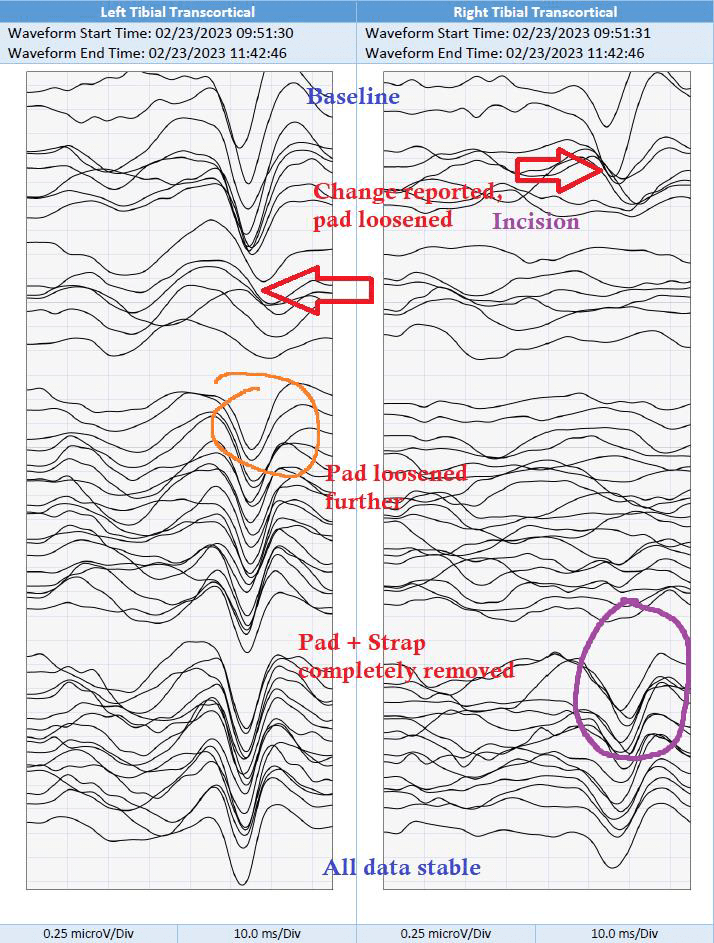
    Shortly after initial traces and baselines – and just around incision – a change in right tibial (Cortical + Transcortical) SSEPs were noted and reported (red arrows). Technical factors such as stimulation failure were ruled out as well as anesthetic factors, which had started at 1.5% and then 2.5% Sevofluorane during positioning, were mitigated by utilizing a total intravenous anesthetic (TIVA). MAP was maintained in the high 70s/low 80s. Propofol and remifentanil were maintained at 100mcg/kg/min and 0.10mcg/kg/min respectively throughout the remainder of the procedure. Left tibial SEPs and bilateral saphenous transcortical responses began to decrease in amplitude and demonstrate morphological changes while these changes were being discussed and troubleshooted.


    The hip pad was not readily viewable due to c-arm telescope blocking, so it was unclear what could have been affecting positioning. Once c-arm was moved, the apparent right pelvic pad was loosened slightly to maintain current desirable positioning. A slight improvement in Right Saphenous and Left Tibial SEP was noted (orange circle) but further deterioration of bilateral Tibial SEPs persisted.


    Right tibial SEPs (Cortical + Transcortical) at this point were nearly abolished. The right pelvic pad was loosened further with moderate recovery of the bilateral saphenous SEPs (green circle).


    Finally, the strap was cut and the pelvic pad was completely removed which allowed for a very rapid return of tibial cortical and transcortical responses (purple circle). These responses remained stable throughout the remainder of the procedure with no additional alerts. The patient went home the following day with no apparent deficit.


    Caution and care should be taken when placing and securing pelvic hip pads and straps. Improper positioning and overtightening of pads can lead to nerve fiber ischemia and peripheral nerve injury.

    Neuromonitoring must begin early and performed continuously throughout all surgical stages to identify changes in IONM data.

    Left & Right Saphenous Cortical SSEPs. Right Saphenous improvement circled in orange. Left saphenous demonstrates mild improvement after initial intervention.
    Left & Right Saphenous Transcortical responses. Improvements circled in green following second attempt at loosening pelvic padding.
    Left & Right Tibial Cortical responses. Changes from baseline noted with red arrow. Improvement circled in purple. Left improved with further loosening, right only returned after complete pelvic pad removal.
    Left & Right Tibial Transcortical responses. Changes from baseline noted with red arrow. Improvements circled in orange and purple. Left improved with further loosening, right only returned after complete pelvic pad removal.


    All data remained stable up and including to the end of monitoring.
  • Clinical Tip #2: Prevention of Needlestick Injuries

    Clinical Tip #2: Prevention of Needlestick Injuries

    Prevention of Needlestick Injuries During IONM

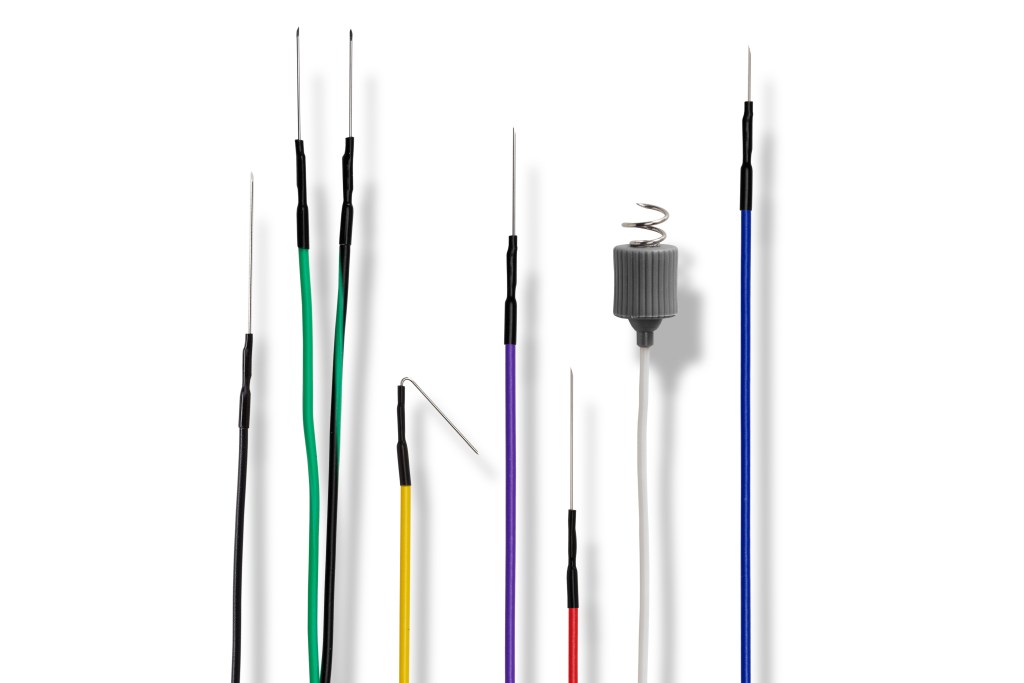
    Subdermal needle electrodes carry inherent risk of needlestick exposure to not only the IONM technologist but other personnel:

    • Needle-stick injuries can expose staff to serious bloodborne pathogens including Hepatitis C, Hepatitis B, and Human Immunodeficiency Virus (HIV).
    • Preventing needle-stick injuries is the best way to protect yourself and others from these infections!
    • According to the CDC, there are around 385,000 reported needlesticks among hospital-based healthcare personnel (2015). More occur in other settings, with potentially half being unreported.
    • Luckily the potential viral load from an IONM needle is low due to there being no hollow bore of the needle, but it is still considered a high risk.

    When and how often do needlestick injuries occur during IONM? Who gets stuck?

    • According to a retrospective study of IONM-related needle-sticks by Tamkus & Rice (2013): There were 174 injuries reported across 50,665 monitored surgeries (0.34% of their group).
    • Most needle-sticks for IONM technologists during removal of the needles (52%), and during patient positioning for non-IONM personnel (67%).
    • For example, surgeons are particularly at risk with abdominal leads during patient positioning when their arms are pulled back which may remove tape and expose the needle.
    • Nurses and anesthesia personnel are at risk during positioning of head, arms, and wrists.
    • Fast turnovers and positioning can add pressure on the IONM technologist to place quickly with improper handling technique.

    Best, acceptable, and unacceptable practices for placement and removal of subdermal needles:

    • Always prep needle sites with an alcohol wipe to prevent infection.
    • Communication: Inform personnel of where needles are placed when they may be hidden due to patient positioning – Back of neck (‘Crv’), behind arms (Triceps), behind legs (Pop Fossa, Gastroc, Femoris). Do not use jargon that may not be quickly understood (“PTN needle is out!”)
    • Troublesome electrodes such as those on the wrists (Ulnar, Brachioradialis, Thenars), abdomen, and legs (Psoas) should also be pointed out. Consider using extra tape or Tegaderm.
    • Slow down placement: Slowing down a beat during placement and properly securing electrodes will save more time than dealing with a needle-stick injury.
    • Remove needles slowly: Ripping all electrodes out from under the drapes at once can cause more problems than they solve. Needles can bend and cause tissue damage & bruising. The wire can break and leave a loose needle under the drapes. It is recommended to hold the electrode wire near the needle, peel away the tape, remove the needle and inspect it.
    • Hold pressure on sites to prevent bleeding. Clean any excess blood and always remove tape and adhesive. Using scissors, cut the extra length of wire from the needle to prevent over-filling the sharps container.
    • An acceptable practice is securing electrode wires with tape if no stress loops are placed. Always ask staff before taping wires to the bed.
    • Removing electrodes by yanking wires from the foot of the bed is unacceptable and potentially harmful to the patient, staff, and yourself!
    • Finally, if a needlestick injury does occur, follow your company’s and hospital’s protocols!

    Tamkus A, Rice K. Risk of Needle-Stick Injuries Associated With the Use of Subdermal Needle Electrodes During Intraoperative Neurophysiologic Monitoring. J Neurosurg Anesthesiol. 2013;26; 65-68

  • Communication in Neuromonitoring

    Communication in Neuromonitoring

    Effective communication and teamwork is essential for the delivery of high quality, safe patient care.

    Failures to communicate are the leading cause of inadvertent patient harm.

    Closed-loop communication (CLC) is essential for safety and precision in healthcare, particularly during complex surgeries involving intraoperative neuromonitoring (IONM). The neuromonitoring clinician cannot effectively do their primary function without clearly and confidently communicating baseline data, early changes, wave loss, or stimulation results.

    (I would say in the context of an “early change”, anything that is an immediately noticeable trace-to-trace difference that I can’t attribute to a technical or anesthetic factor warrants at least a brief notification.)

    In surgical environments, situational awareness is vital. CLC enhances this awareness by ensuring that all information is not only shared but acknowledged and confirmed by the appropriate team members.

    Phrases like “Dr, I have a complete loss of right leg and foot MEP responses” or “Responses have returned after increasing the MAP” must be acknowledged aloud by the surgeon or anesthesiologist to confirm shared understanding and coordinated action.

    Teams should use effective tools and structured communication behaviors, such as the SBAR technique (Situation, Background, Assessment, Recommendation). For example:

    • S: “We’ve lost MEPs in the left lower extremity.”
    • B: “Signals were stable prior to osteotomy.”
    • A: “This may indicate some level of spinal cord compromise.”
    • R: “Recommend surgical pause, increase in MAP, and re-testing after a few minutes.”

    Using critical language – clear, standardized phrases that denote urgency or required action – also supports rapid response. Terms like “Signal loss,” or “Absent after…,” convey priority issues that must be addressed without delay. Hinting and hoping that you have been heard is fraught with hazard.

    There is a hierarchy in medicine, and while it may be difficult to speak up with concerns due to certain power structure, cultural norms, or uncertainty, the ability to get everyone to stop and listen is essential for safe care. The reliability of IONM is threatened when the clinician’s role is neglected, and the decision to change course of a surgery relies heavily upon the communicator.

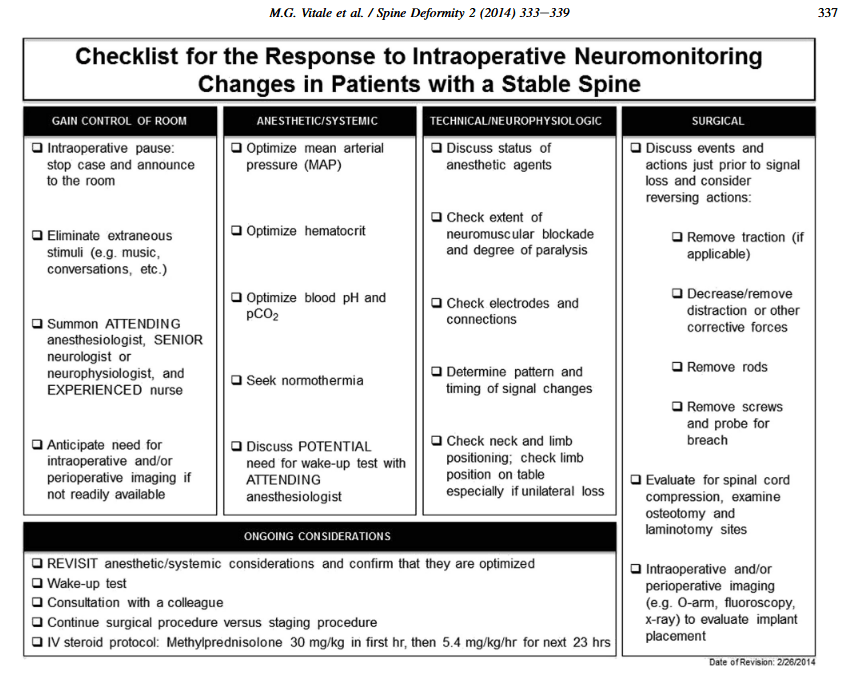
    Checklists can be extremely useful to ease cognitive burden when faced with potential significant changes. And while there’s no substitute for being having situational awareness, we must all be cognizant and anticipate “the next steps” when dealing with waveform loss. See the following from Vitale 2014, a classic in the IONM world.

    As neuromonitoring clinicians, we must overcome the heavy cognitive bias of the surgeon when there is a change. They will (understandably) want to see their carefully planned procedure through to the end, and experience with changes and patients waking with no or extremely minimal deficit can prohibit taking action when there is potentially serious change.

    Maintaining team alignment through frequent communication about patient history, surgical milestones, and frequency of testing ensures the neuromonitoring clinician is integrated – not isolated – in the care process.

    Ultimately, we must all be accountable for the patient. Every team members commitment to structured, reliable communication, shared awareness, and mutual respect ensures the best possible outcome for the patient.

    For more reading, I suggest:

    Dormans JP: Establishing a standard of care for neuromonitoring during spinal deformity surgery. Spine (Phila Pa 1976). 35:2180–2185, 2010

    Leonard M, Graham S, Bonacum D: The human factor: the critical importance of effective teamwork and communication in providing safe care. Qual Saf Health Care; 13 (Suppl 1):i85-i90, 2004

    Vitale MG, Skaggs DL, Pace GI, Wright ML, Matsumoto H, Anderson RC, et al: Best practices in intraoperative neuromonitoring in spine deformity surgery: development of an intraoperative checklist to optimize response. Spine Deform 2:333–339, 2014

  • Clinical Tip #1: Be Early

    Clinical Tip #1: Be Early

    It sounds simple enough.

    But being early permits you to take advantage of a lot.

    First, the earlier you are, the more likely you are to learn that your case has canceled because your patient had coffee with cream and you can go back to bed. Kidding. Sort of.

    Many of us performing IONM are not employed by a hospital system, but rather are contracted clinicians through a third-party company. Technically, we can show up basically whenever, as long as we get the job done. But…

    The best advantages, in my mind, come from the reduced stress and anxiety of setting things up. Ask yourself: “Do I have all of the tools I need for today? Probes, check. Stimulator clips, check. Electrodes, check.”

    Do I have ample time to turn on my system and confirm its proper functioning? There’s nothing worse than a patient rolling in the room and your MEP stimulator isn’t connecting and you need a new one. You could have figured that out before anesthesia started!

    Being early allows you to shape your workspace and mentally prepare your flow. Early hours are often quieter, offering better concentration and fewer interruptions. Preparedness is confidence, and confidence is calming. Not just to you, but to everyone in the room.

    I recently did monitoring for a case where I called before I left for an afternoon start, confirmed on-time, showed up, and the patient was being positioned. It happens. I was wholly unprepared, and although I knew what I was doing, the setup was extensive and I was definitely not calm. In fact – I could’ve been better. Luckily I had a patient surgeon and good data, but I did not know what I was walking into because I had nothing prepared and hadn’t spoken to the patient.

    After that case, I remained on high stress for a little while after. I feel that when your workday begins slowly and smoothly, you are much less likely to carry that tension home, which enhances work-life balance.

    In general, my rule of thumb is: Clothes changed into scrubs 1 hour before first-start cases, 1.5 hours before afternoon starts. Let me know when you like to show!